

How To Install Tire Pressure Monitoring System
A tire-pressure monitoring system (TPMS) monitors the air pressure inside the pneumatic tires on vehicles.[i] A TPMS reports real-time tire-pressure information to the commuter, using either a judge, a pictogram brandish, or a uncomplicated low-force per unit area warning calorie-free. TPMS tin exist divided into two different types – directly (dTPMS) and indirect (iTPMS).
TPMS are installed either at when vehicle made or afterward the vehicle is put to utilize. The goal of a TPMS is avoiding traffic accidents, poor fuel economy, and increased tire clothing due to under-inflated tires through early recognition of a chancy state of the tires. This functionality first appeared in luxury vehicles in Europe in the 1980s, while mass-market adoption followed the Usa passing the 2000 TREAD Deed after the Firestone and Ford tire controversy.
Mandates for TPMS technology in new cars take connected to proliferate in the 21st century in Russia, the European union, Nihon, Republic of korea and many other Asian countries. From November 2022 TPMS was mandatory for new vehicles in the European Matrimony; in a survey carried out between November 2022 and August 2022, 54% of rider cars in Sweden, Germany, and Kingdom of spain were institute non to have TPMS, a figure believed to be an under-gauge.[2]
Valve dTPMSes, which crave a smartphone and an app, are also available for bicycles.[iii]
History [edit]
Initial adoption [edit]
Due to the influence tire pressure has on vehicle safety and efficiency, tire-pressure monitoring (TPM) was adopted by the European market as an optional feature for luxury rider vehicles in the 1980s. The first passenger vehicle to adopt TPM was the Porsche 959 in 1986, using a hollow spoke wheel organisation adult by PSK. In 1996 Renault used the Michelin PAX system[4] for the Breathtaking and in 1999 the PSA Peugeot Citroën decided to prefer TPM as a standard feature on the Peugeot 607. The following year (2000), Renault launched the Laguna 2, the first high book mid-size passenger vehicle in the world to exist equipped with TPM as a standard feature.
In the United States, TPM was introduced by General Motors for the 1991 model year for the Corvette in conjunction with Goodyear run-apartment tires. The organisation uses sensors in the wheels and a commuter brandish which can show tire pressure level at any wheel, plus warnings for both high and depression pressure. Information technology has been standard on Corvettes e'er since.
Firestone call back and legal mandates [edit]
The Firestone remember in the late 1990s (which was linked to more than 100 deaths from rollovers following tire tread-separation), pushed the United States Congress to legislate the TREAD Act. The Human action mandated the employ of a suitable TPMS technology in all calorie-free motor vehicles (under 10,000 lb (four,500 kg)), to assist alarm drivers of under-inflation events.
This act affects all lite motor vehicles sold afterward September one, 2007. Phase-in started in Oct 2005 at 20%, and reached 100% for models produced after September 2007. In the The states, as of 2008 and the European Marriage, as of November 1, 2022, all new rider car models (M1) released must be equipped with a TPMS. From November i, 2022, all new passenger cars sold in the European Spousal relationship must exist equipped with a TPMS. For N1 vehicles, TPMS are non mandatory, just if a TPMS is fitted, it must comply with the regulation.
On July 13, 2022, the South Korean Ministry of Country, Transport and Maritime Affairs announced a pending partial-revision to the Korea Motor Vehicle Condom Standards (KMVSS), specifying that "TPMS shall exist installed to passenger vehicles and vehicles of GVW iii.v tons or less, ... [effective] on January one, 2022 for new models and on June 30, 2022 for existing models".[5] Japan is expected to adopt European Union legislation approximately 1 twelvemonth subsequently European Union implementation. Further countries to brand TPMS mandatory include Russian federation, Indonesia, the Philippines, Israel, Malaysia and Turkey. After the TREAD Act was passed, many companies responded to the market opportunity by releasing TPMS products using battery-powered radio transmitter wheel modules.
Run-flat tires [edit]
The introduction of run-apartment tires and emergency spare tires by several tire and vehicle manufacturers has motivated to make at least some basic TPMS mandatory when using run-flat tires. With run-flat tires, the driver will most likely not observe that a tire is running flat, hence the so-called "run-apartment alarm systems" were introduced. These are nigh oft first generation, purely roll-radius based iTPMS, which ensure that run-flat tires are non used beyond their limitations, normally 80 km/h (50 mph) and lxxx km (50 miles) driving distance. The iTPMS market has progressed equally well. Indirect TPMS are able to detect under-inflation through combined utilise of roll radius and spectrum analysis and hence four-cycle monitoring has become feasible. With this breakthrough, coming together the legal requirements is possible also with iTPMS.
Direct versus indirect [edit]
Indirect TPMS [edit]
Indirect TPMS (iTPMS) do not apply concrete pressure sensors but measure air pressures using software-based systems, which by evaluating and combining existing sensor signals like cycle speeds, accelerometers, driveline data, etc. estimate and monitor the tire pressure level without physical pressure level sensors in the wheels. First-generation iTPMS systems are based on the principle that under-inflated tires accept a slightly smaller bore (and hence higher angular velocity) than a correctly inflated ane. These differences are measurable through the bicycle speed sensors of ABS/ESC systems. Second generation iTPMS can also detect simultaneous under-inflation in up to all 4 tires using spectrum analysis of individual wheels, which can be realized in software using advanced signal processing techniques.
iTPMS cannot measure or brandish absolute pressure level values; they are relative by nature and accept to be reset past the commuter one time the tires are checked and all pressures adjusted correctly. The reset is commonly washed either past a physical button or in a menu of the on-board estimator. iTPMS are, compared to dTPMS, more sensitive to the influences of dissimilar tires and external influences similar road surfaces and driving speed or way. The reset procedure,[6] followed by an automated learning phase of typically xx to 60 minutes of driving under which the iTPMS learns and stores the reference parameters earlier information technology becomes fully active, cancels out many, but not all of these. As iTPMS do not involve any boosted hardware, spare parts, electronic/toxic waste material, or service (across the regular reset), they are regarded as easy to handle and customer friendly.[7] Every bit mentioned notwithstanding, the sensors must exist reset every fourth dimension changes are done to the tire setup, and some consumers do non wish to have this added responsibility.[8]
Since factory installation of TPMS became mandatory in November 2022 for all new rider vehicles in the European union, various iTPMS have been type-approved according to UN Regulation R64. Examples for this are most of the VW group models, simply likewise numerous Honda, Volvo, Opel, Ford, Mazda, PSA, FIAT and Renault models. iTPMS are quickly gaining market shares in the European union and are expected to go the dominating TPMS applied science in the near time to come.
iTPMS are regarded as less accurate by some due to their nature—given that simple ambient temperature variations can pb to pressure variations of the aforementioned magnitude every bit the legal detection thresholds— only many vehicle manufacturers and customers value the ease of use.[ citation needed ]
Directly TPMS [edit]

direct TPM sensor fitted in valve system, manufacturer VDO

A damaged directly TPMS sensor existence removed
Direct TPMS (dTPMS) directly measures tire pressure using hardware sensors. In each bicycle, nigh often on the within of the valve, there is a battery-driven pressure sensor which transfers pressure data to a central control unit which reports information technology to the vehicle'southward onboard estimator. Some units too mensurate and alert temperatures of the tire as well. These systems tin identify under-inflation for each individual tire. Although the systems vary in transmitting options, many TPMS products (both OEM and aftermarket) can display realtime, individual tire pressures whether the vehicle is moving or parked. There are many unlike solutions, but all of them have to confront the problems of exposure to hostile environments. The majority are powered past batteries which limit their useful life. Some sensors employ a wireless ability system like to that used in RFID tag reading which solves the trouble of limited battery life. This also increases the frequency of data manual upward to 40 Hz and reduces the sensor weight which can be important in motorsport applications. If the sensors are mounted on the outside of the bike, equally are some aftermarket systems, they are field of study to mechanical damage, aggressive fluids, as well as theft. When mounted on the inside of the rim, they are no longer easily accessible for bombardment change and the RF link must overcome the attenuating furnishings of the tire which increases the energy need.
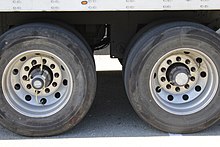

Because dual wheel assemblies are side by side on each axle hub, a pressure level sensor is connected to each of the two tires, through the two pressure lines shown in the photo.
A direct TPMS sensor consists of the following chief functions requiring only a few external components — e.grand. battery, housing, PCB — to get the sensor module that is mounted to the valve stem inside the tire:
- force per unit area sensor;
- analog-digital converter;
- microcontroller;
- organization controller;
- oscillator;
- radio frequency transmitter;
- low frequency receiver, and
- voltage regulator (bombardment management).
Near originally fitted dTPMS take the sensor mounted on the inside of the rim and the batteries are not exchangeable. A discharged battery means that the tire must exist dismounted in gild to supplant it, so long battery life is desirable. To save energy and prolong bombardment life, many dTPMS sensors do not transmit information when parked (which eliminates spare tire monitoring) or employ a more than ability expensive two-fashion communication which enables wake-up of the sensor. For OEM auto dTPMS units to piece of work properly, they need to recognize the sensor positions and must ignore the signals from other vehicles.
Aftermarket dTPMS units not only transmit while vehicles are moving or parked, but likewise provide users with some advanced monitoring options including information logging, remote monitoring options and more than. They are available for all types of vehicles, from motorcycles to heavy equipment, and can monitor up to 64 tires at a time, which is of import for commercial vehicles. Many aftermarket dTPMS units do not require specialized tools to program or reset, making them much simpler to utilise.
Maintenance issues [edit]
Valve-stem corrosion [edit]
First-generation of TPMS sensors that are integral with the valve stem have suffered from corrosion.[9] [ten] Metal valve caps tin can become seized to the valve stem because of galvanic corrosion of dissimilar metals, and efforts to remove it can intermission the stem, destroying the sensor. A similar fate may befall an subsequently-market brass valve core inside the stalk that may have been installed by unwary technician, replacing the original specialized nickel-coated cores. (They tin can be distinguished by the yellowish colour of the brass.) Seizure of the valve can complicate repair of a tire leak, possibly requiring replacement of the entire sensor.
Tire sealant compatibility [edit]
There is controversy regarding the compatibility of after-market tire sealants with dTPMS that employ sensors mounted inside the tire. Some manufacturers of sealants assert that their products are indeed uniform,[11] but others warned that the "sealant may come in contact with the sensor in a way that renders the sensor temporarily inoperable until it is properly cleaned, inspected and re-installed by a tire intendance professional".[12] Such doubts are also reported by others.[thirteen] [14] Use of such sealants may void the TPMS sensor warranty.[11]
Benefits of TPMS [edit]
The dynamic beliefs of a pneumatic tire is closely connected to its inflation force per unit area. Key factors like braking distance and lateral stability require the inflation pressures to be adjusted and kept every bit specified by the vehicle manufacturer. Farthermost under-aggrandizement can even pb to thermal and mechanical overload caused by overheating and subsequent, sudden destruction of the tire itself. Additionally, fuel efficiency and tire habiliment are severely affected by nether-inflation. Tires do not merely leak air if punctured, they also leak air naturally, and over a year, even a typical new, properly mounted tire tin lose from 20 to sixty kPa (3 to 9 psi), roughly ten% or fifty-fifty more of its initial pressure.
The significant advantages of TPMS are summarized equally follows:
- Fuel savings: According to the GITI, for every 10% of under-inflation on each tire on a vehicle, a i% reduction in fuel economy will occur. In the U.s. lone, the Department of Transportation estimates that nether inflated tires waste 2 billion Usa gallons (7,600,000 m3) of fuel each twelvemonth.
- Extended tire life: Nether inflated tires are the number one cause of tire failure and contribute to tire disintegration, heat buildup, ply separation and sidewall/casing breakdowns. Further, a divergence of 10 pounds per square inch (69 kPa; 0.69 bar) in pressure on a ready of duals literally drags the lower pressured tire 2.5 metres per kilometre (thirteen feet per mile). Moreover, running a tire even briefly on inadequate pressure breaks down the casing and prevents the power to retread. It is of import to note that non all sudden tire failures are acquired by under-aggrandizement. Structural damages caused, for example, past hitting sharp curbs or potholes, tin also pb to sudden tire failures, even a sure time afterwards the damaging incident. These cannot exist proactively detected by any TPMS.
- Improved safety: Under-inflated tires atomic number 82 to tread separation and tire failure, resulting in forty,000 accidents, 33,000 injuries and over 650 deaths per yr. Farther, tires properly inflated add together greater stability, handling and braking efficiencies and provide greater safety for the driver, the vehicle, the loads and others on the road.
- Environmental efficiency: Nether-inflated tires, equally estimated past the U.s. Department of Transportation, release over 26 billion kilograms (57.five billion pounds) of unnecessary carbon-monoxide pollutants into the atmosphere each twelvemonth in the United States lonely.
Further statistics include:
The French Sécurité Routière, a route condom organization, estimates that ix% of all road accidents involving fatalities are attributable to tire under-inflation, and the German language DEKRA, a production rubber organization, estimated that 41% of accidents with physical injuries are linked to tire problems.[ citation needed ]
The Eu reports that an boilerplate under-inflation of 40 kPa produces an increase of fuel consumption of ii% and a decrease of tire life of 25%. The European Spousal relationship concludes that tire nether-inflation today is responsible for over 20 million liters of unnecessarily-burned fuel, dumping over 2 million tonnes of CO2 into the atmosphere, and for 200 million tires being prematurely wasted worldwide.[ citation needed ]
In 2022, a field study on TPMS and tire inflation pressure was published on the UN ECE Working Party on Brakes and Running Gear (GRRF) homepage.[15] It covered one,470 randomly selected vehicles in three European union countries with dTPMS, iTPMS and without TPMS. Chief findings are that TPMS fitment reliably prevents severe and dangerous underinflation and hence yields the desired effects for traffic safety, fuel consumption and emissions. The study as well showed that there is no deviation in effectiveness between dTPMS and iTPMS and that the TPMS reset function does not present a safety risk.
Privacy concerns with straight TPMS [edit]
Considering each tire transmits a unique identifier, vehicles may exist easily tracked using existing sensors along the roadway.[16] This business could be addressed past encrypting the radio communications from the sensors but such privacy provisions were non stipulated by the NHTSA.
Heavy-duty vehicles [edit]
U.S. National Highway Traffic Safety Assistants regulations[17] only apply to vehicles under 10,000 pounds. For heavy-duty vehicles (Classes 7 and viii, gross vehicle weight greater than 26,000 pounds), most of the to a higher place-mentioned systems don't work well, requiring the development of other systems.
The US Department of Transportation has commissioned several studies to find systems that piece of work on the heavy-duty market specifying some goals that were needed in this marketplace.[18] [19]
The SAE has tried to disseminate all-time practices since legal regulations for heavy vehicles has been lagging.[xx]
Compulsory [edit]
America [edit]
The first country to accept TPMS mandatory was the U.s. of America. In the early on 2000s, numerous traffic accidents such as rollovers and tyre blowouts occurred due to insufficient air pressure level. NHTSA regarded apartment tyres as a potential threat to safety which was soon followed by the enactment of the police force on attaching TPMS for every vehicle in September 2007.[21]
South korea [edit]
TPMS became obligatory for every vehicle under iii.5t sold afterwards 2022. Later in 2022, every vehicle had to have TPMS regardless of its size. In 2022, Hyundai Mobis successfully developed the TPMS and first practical it in the Veloster. As a effect, the sensor's power usage is about 30% lower than that of existing products, reducing battery size and reducing sensor weight by more than 10%.[22]
Icons [edit]
TPMS system dashboard icons
-

TPMS low pressure warning icon
-

TPMS system failure icon
See too [edit]
- Central tire inflation system
- Common cold inflation pressure
- Nira Dynamics AB
- Tire-force per unit area estimate
- Loose wheel nut indicator
References [edit]
- ^ Reina, Giulio (2015). "Tyre pressure monitoring using a dynamical model-based estimator". Vehicle Organisation Dynamics: 29. doi:x.1080/00423114.2015.1008017.
- ^ TPMS Fitment and Tyre Inflation Pressures, Field Written report EU 2022/2017 - Informal document, 86th GRRF session (PDF). United nations Economic Commission for Europe (UNECE) (Study). Feb 12–16, 2022. GRRF-86-17.
- ^ Langley, Jim (September two, 2022). "StatCap P1 Tire Pressure Monitoring System (TPMS) Review". Road Bicycle Passenger.
- ^ "Archived copy". Archived from the original on May 4, 2022. Retrieved Oct 26, 2022.
{{cite spider web}}: CS1 maint: archived copy as championship (link) PAX organization description on Michelinman site - ^ Government minister Chung, Jung-hwan. "The Ministry of Land, Ship and Maritime Affairs" (PDF). Revisions to the Korean Motor Vehicle Condom Standards (KMVSS). The Ministry of Land, Transport and Maritime Affairs, Korea.
- ^ "How to Reset a Tire Pressure level Sensor". CAPITOL-TIRES.com.
- ^ http://www.elektronikpraxis.vogel.de/sensorik/articles/172243/ Reifendruck voll unter Kontrolle
- ^ Direct TPMS Versus Indirect TPMS | Schrader TPMS Solutions
- ^ Sean Phillips (2014). "Achey Breakey Parts: TPMS And Corrosion". ABOUT.COM. Retrieved Oct 15, 2022.
- ^ "Real-World TPMS Tips & Tricks". Tire Review. Babcox Media, Inc. August 23, 2022. Retrieved October 17, 2022.
- ^ a b "Ride-On TPS Tire Sealants and Tire Force per unit area Monitoring Systems (TPMS)". Retrieved October fifteen, 2022.
- ^ "Faqs: Is Slime TPMS Safe?". 2022. Retrieved October 15, 2022.
- ^ "Convenient tire sealants to fix a flat tire; Evaluations show that compressor kits are improve than aerosol sealers". Retrieved October xv, 2022.
- ^ "Common TPMS Service Questions and Answers". July 16, 2022. Retrieved October 15, 2022.
- ^ https://www.unece.org/fileadmin/DAM/trans/doc/2018/wp29grrf/GRRF-86-17e.pdf[ blank URL PDF ]
- ^ Schneier, Bruce (April 10, 2008). "Tracking Vehicles through Tire Pressure Monitors". Schneier on Security . Retrieved Dec ten, 2022.
- ^ 49 CFR, Ch. Five., FMVSS No. 138, 2006
- ^ An Evaluation of Existing Tire Force per unit area Monitoring Systems. U.S. Dept. of Transportation. DOT HS 809 297.
- ^ Grygier, Paul; Daniel Jr., Samuel; Hoover, Richard; Van Buskirk, Timothy (June 2009). Testing of Heavy Truck Tire Pressure Monitoring Systems (TPMS) in order to Define an Credence Procedure. 21st International Technical Conference on the Enhanced Safety of Vehicles. 09-0551.
- ^ Daniel, S. 2005. Condition of TPMS Rulemaking, SAE Government/Industry Meeting - May ten, 2005
- ^ "What Does TPMS Hateful?". 《Cars》 . Retrieved May 31, 2022.
- ^ "Due south Korea to make TPMS mandatory". 《Tire Business》 . Retrieved July 13, 2022.
External links [edit]
-
 Media related to Tire-pressure monitoring systems at Wikimedia Commons

Source: https://en.wikipedia.org/wiki/Tire-pressure_monitoring_system
Posted by: newsomithoust.blogspot.com
0 Response to "How To Install Tire Pressure Monitoring System"
Post a Comment